Charlie Chaplin
“If a work of art needs analysis or explanation to be understood, I question whether it has truly achieved its purpose.” — Charlie Chaplin
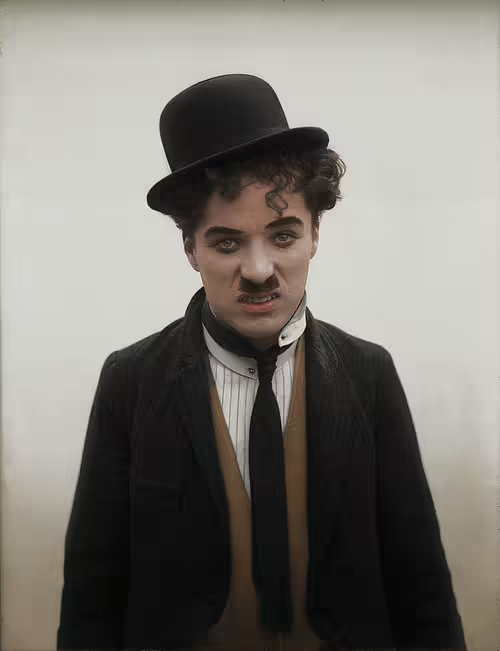 Charlie Chaplin
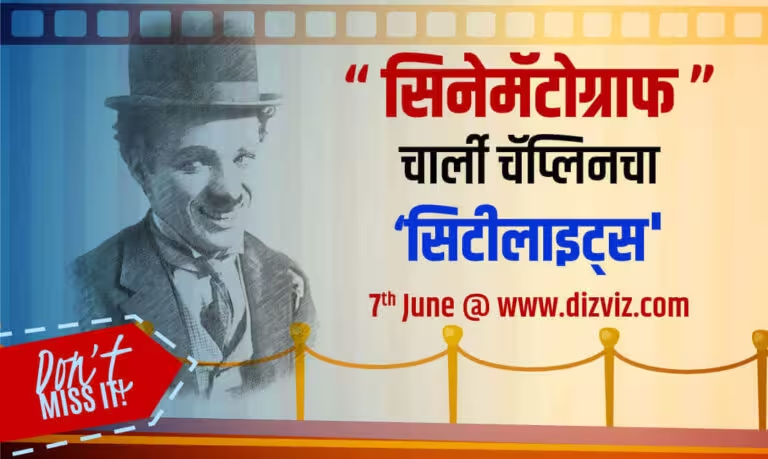
Before writing anything about Charlie Chaplin’s extraordinary film City Lights, I remembered this very quote by him—and paused. It is true that great art often invites interpretation, yet writing about it also serves a purpose. One aim is to repay the joy that such art gives us, and to share that joy with others. Also, writing about art is not always commentary—it is often an attempt to understand ourselves better.
City Lights was released in 1931, but its production took nearly three years. During this time, the film industry was undergoing a major revolution—the arrival of sound. Cinema had found its voice, and this transformation had far-reaching effects. Audiences were naturally attracted to this new technology, and producers feared silent films would become obsolete. As a result, many silent film artists struggled, especially those who lacked proper speech or diction. Theatre actors began entering films, and gradually cinema became more dialogue-heavy.
However, Charlie Chaplin refused to accept this change hastily. He stubbornly chose to keep City Lights a silent film, using sound only in limited parts. Interestingly, this was also the first time he composed background music for his film. Chaplin believed that if his iconic Tramp character started speaking English, it would limit his universality. Facial expressions, he felt, were a global language—and he was proven right after the film’s release.
Chaplin did not believe in simply giving audiences what they wanted. While his goal was to make people laugh, he was not a people-pleaser. He famously said, “I do not believe the public knows what it wants.” With such a belief, an artist carries the responsibility of guiding the audience—and Chaplin embraced that responsibility fully. He worked tirelessly, often taking dozens of retakes for a single scene. For City Lights, he shot over 314,000 feet of film, eventually refining it into just 8,000 feet of cinematic brilliance.
Initially, Chaplin had considered playing a blind clown in the film. Later, he changed the idea and cast a young actress, Virginia Cherrill, as the blind flower girl. Though inexperienced, she followed Chaplin’s instructions precisely. To help her portray blindness, he advised: “Look inward, don’t look at me.” His direction style was demanding, and their relationship was not always smooth. At one point, he even replaced her, only to later realize she was perfect for the role and bring her back.
The film’s premiere was grand. In Los Angeles, Albert Einstein attended, while in London, George Bernard Shaw was the chief guest.
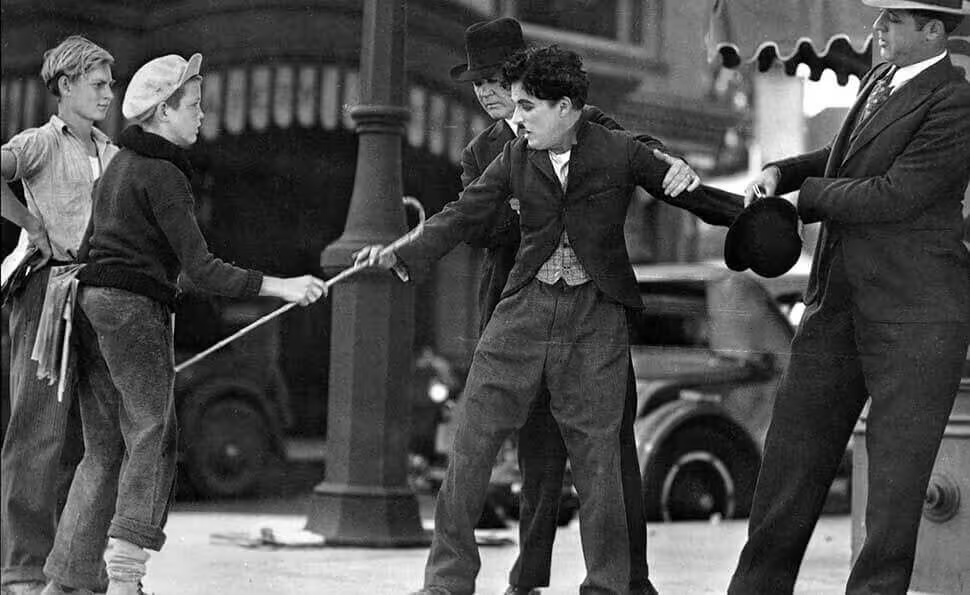
Story of City Lights
The story is simple yet deeply touching. A poor tramp meets a blind flower girl who mistakenly believes he is wealthy. Gradually, he falls in love with her and struggles to arrange money for her eye surgery.
To help her, he encounters a wealthy man who is suicidal. The tramp saves him, and in his drunken state, the millionaire becomes emotional and befriends him. However, when sober, he forgets him completely. This contrast creates both humor and depth.
To gather money, the tramp even participates in a boxing match—one of the most iconic comedic sequences in cinema history. As critic Roger Ebert said, “It is the funniest sporting event ever filmed.”
Eventually, the tramp manages to give the money to the girl but is arrested as a suspected thief. After serving time, he returns—only to find her cured and running a flower shop.
In the final scene, she offers him a flower and touches his hand—and in that moment, she recognizes him. What her eyes could not see before, her touch reveals instantly.
He asks, “You can see now?”
She replies, “Yes, I can see now.”
In that moment, she sees everything—his poverty, innocence, love, and sacrifice. It is one of the most powerful and emotional scenes in film history.
Chaplin later said about this scene:
“I was not acting… I simply stepped aside and watched.”
Conclusion
This film makes us laugh, moves us deeply, and leaves us wiser. Many critics consider its final scene among the greatest ever filmed. It has influenced countless artists and writers.
As critic Mark Bonen wrote:
“If we were to send a time capsule into space representing human culture, a work like City Lights would be a perfect choice.”