From moving images on a screen to meaningful visual compositions, cinema has made a remarkable journey. Over a hundred years, this series introduces the great filmmakers who gave cinema the status of an art form…
Location: Salon Indien du Grand Café, Paris. December 1895.
In the specially decorated basement of the Grand Café in a luxurious area of Paris, elite people, artists, and art lovers had gathered with great curiosity. The reason was equally important. A magical invention of light, never shown anywhere in the world before, was about to be presented.
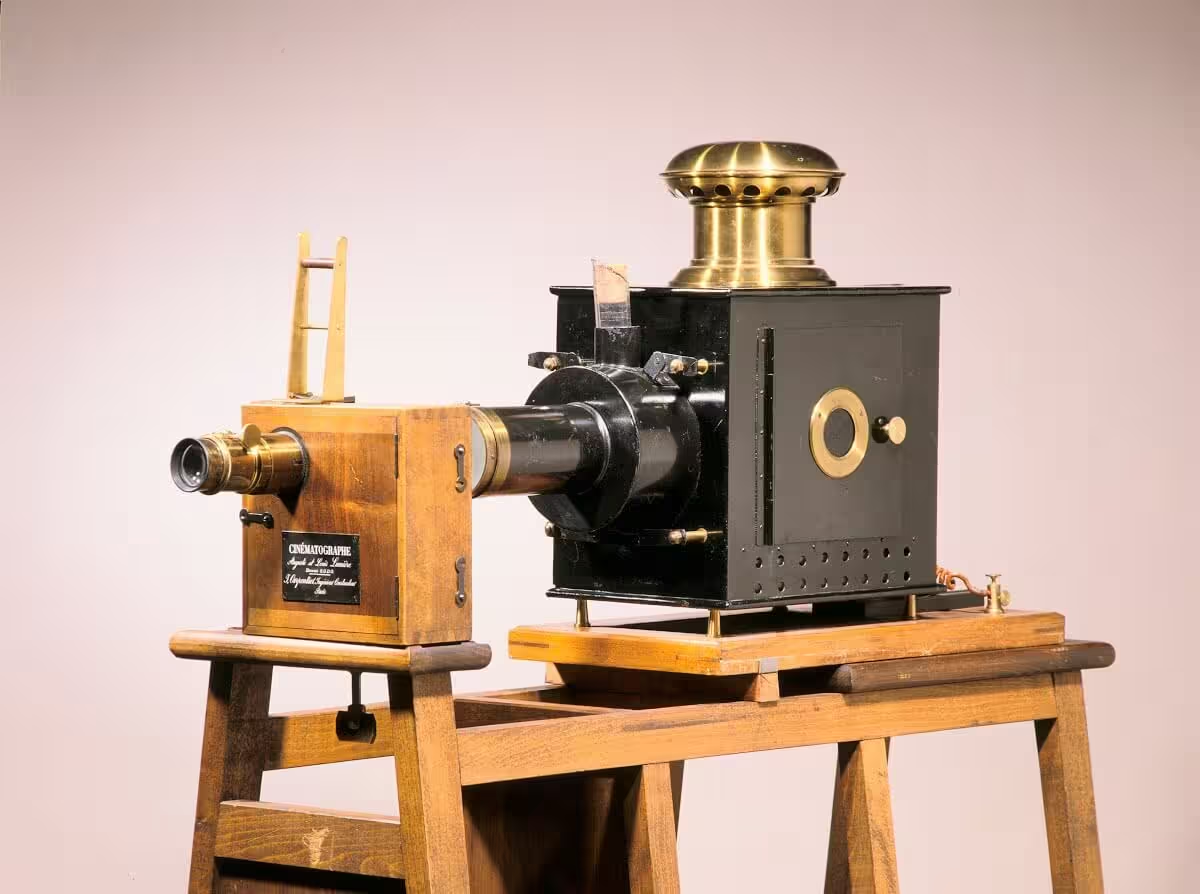
Two brothers, Louis and Auguste Lumière, were going to demonstrate this magic of “moving images on a screen.” The Lumière brothers brought their strange-looking machine into the hall. This device, called the “Cinematograph,” was a box with a glass lens in front. As the handle outside was turned, moving and running people appeared on the wall.
Just 46 seconds. But within that, every person in the hall felt they had witnessed something extraordinary. This was the first glimpse of the art that would later mesmerize the entire world as cinema. The ability of this art to amaze people in different ways has not ended and will continue.
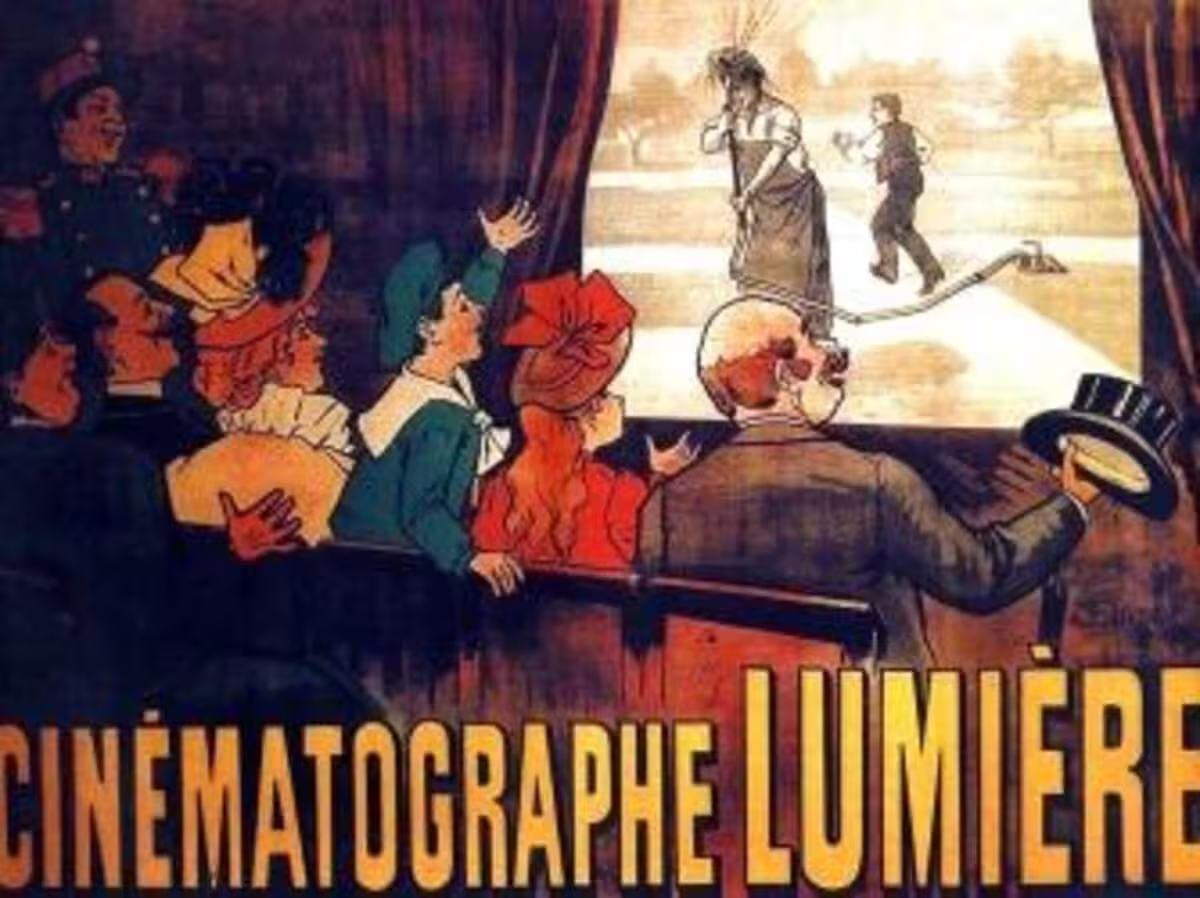
So, I was talking about the birth of this art…
Generally, the birth of cinema is considered to be on 29-12-1895. When a plant emerges from the soil, we say it is born. But the process begins much earlier. The same happened with cinema.
Even before the Lumière brothers, many creative individuals had sensed this new art. In October 1888, Louis Le Prince of Yorkshire created a two-second moving film. Some scholars consider it the oldest motion picture in existence.
The great scientist and inventor Edison also conducted extensive research in this field. He created two devices called the “Kinetograph” and “Kinetoscope.” But for some reason, Edison did not take his inventions seriously, nor did he pursue them or patent them.
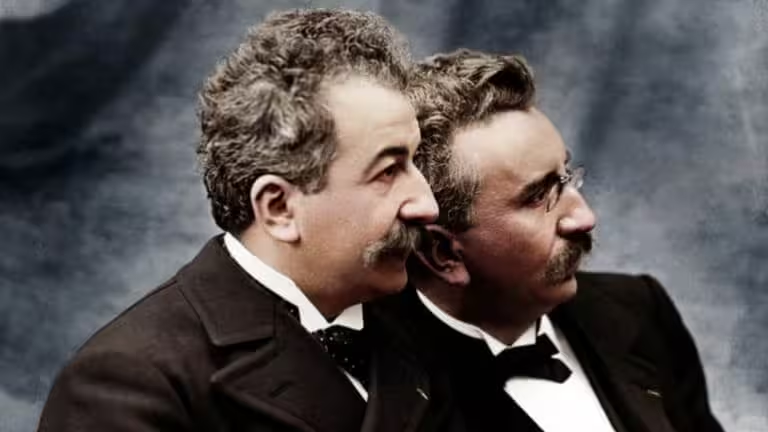
Auguste Lumière was born in 1862 and Louis Lumière in 1864 in France. Their father owned a photographic firm, and the two brothers assisted him. Louis handled the technical side, while Auguste managed operations. Louis was a highly creative technician who invented the important dry plate process in still photography.
In 1892, after their father retired, the brothers devoted themselves to making motion pictures. They created the “Cinematograph” and patented it. On 13 February 1895, they captured their first moving image of workers leaving their factory.
In the first show on 29 December, the Lumière brothers presented ten films. These films were very short, none exceeding one minute.
The films shown by the Lumière brothers were: Workers Leaving the Lumière Factory (46 seconds), Horse Trick Riders (46 seconds), Fishing the Goldfish (42 seconds), Disembarkment (48 seconds), Blacksmith (49 seconds), Sprinkler Sprinkled (49 seconds), Baby’s Breakfast (41 seconds), Jumping onto the Blanket (41 seconds), A Street Scene (44 seconds), Bathing in the Sea (38 seconds). Interestingly, the first steps toward major cinematic directions were unknowingly taken that very day—documentary and social themes (Workers Leaving Factory), family film (Baby’s Breakfast), comedy (Sprinkler Sprinkled).
The experiment of the Lumière brothers became unbelievably successful. It became so popular that they traveled across the world showcasing their films. Records show they even presented them in India on 7 July 1896.
However, surprisingly, the Lumière brothers were doubtful about the future of this art. They themselves called it “an invention without any future.” It remains a mystery why the creators of cinema could not foresee its possibilities. They did not focus much on filmmaking afterward and instead worked on developing color photography.
With the beginning of the 20th century, curiosity about this new art spread worldwide. Many technicians and artists began experimenting. The first stage of development was increasing film length. Gradually, films of five, ten, and fifteen minutes were made.
Initially, only sequences of scenes were shown. Later, the idea of telling a story through film emerged. For storytelling, new techniques were needed. Thus, film techniques developed. Editing became an important concept. It allowed different time layers to appear simultaneously on screen, expanding cinematic possibilities greatly.
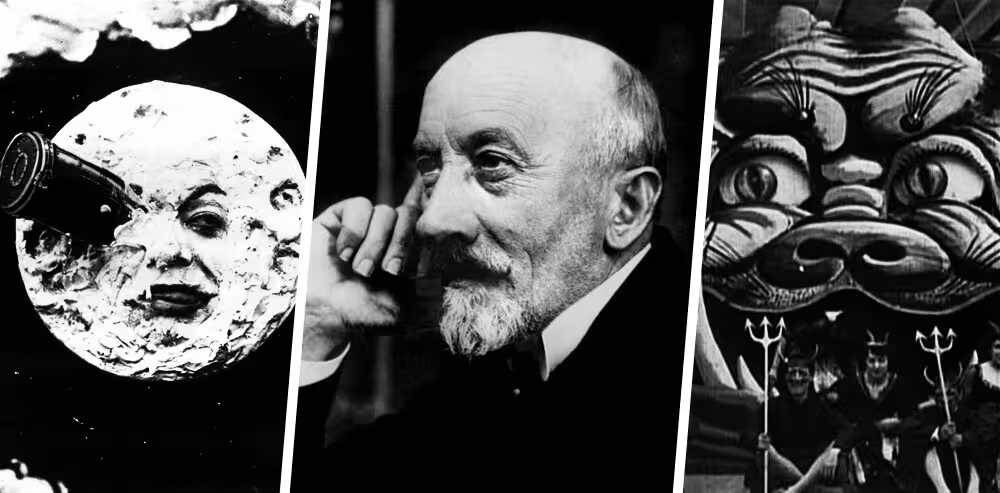
One of the first notable experiments was done by Georges Méliès with “A Trip to the Moon” (1902). Based on Jules Verne’s idea, it became the world’s first science fiction film. It was only 14 minutes long, so the story was presented briefly.
Méliès was originally a magician, so he brought magic into cinema. His film “The Devil’s Manor” became the first colored film, where each frame was hand-painted.
Once, while shooting on a street, his camera stopped working. After fixing it, he resumed shooting, accidentally creating overlapping visuals. This led to the development of the “overprinting” technique. Méliès is known as the “Father of Film Fantasy.”
The next important director was Edwin Porter. He introduced fundamental changes in filmmaking. He discovered cross-cutting, placing one scene between others to create meaning and suspense.
For the first time, he placed a camera on a tall building and used a panning shot. This allowed him to capture vast spaces.
Porter’s most important film was “The Great Train Robbery” (1903). This 12-minute action film told the story of a train robbery and the sheriff’s pursuit. The final shot, where a character fires directly at the camera, frightened audiences.
Cinema gradually became more popular. However, it also faced criticism. Since it combined multiple arts like painting, music, literature, and theatre, it was criticized.
Writer Virginia Woolf wrote that cinema was born fully dressed, trying to say too much without having enough to say.
However, great thinkers like Tolstoy recognized its power. He called cinema a “medium blessed with divine motion.”
In less than a hundred years, cinema has progressed remarkably—from silent films to sound films, black and white to color, 16mm to 70mm, and now digital cinema. It has achieved great heights in both content and expression.
With digital technology, filmmaking is becoming more accessible. Just as poets share poetry, filmmakers may soon show their films instantly.
We will explore this journey through 51 directors.
The first director will be: D. W. Griffith.
Vijay Padalkar